Category: <span>Google my business</span>

Generative Engine Optimization (GEO) for Chennai businesses to improve visibility on ChatGPT, Gemini and Google AI Overviews. Google my business

Explore Generative Engine Optimization (GEO) strategies to help Chennai…

Imagine someone searching for a digital marketing agency in Chennai. Instead of opening Google and visiting five or six websites, they simply ask ChatGPT, Gemini or another AI tool for recommendations.
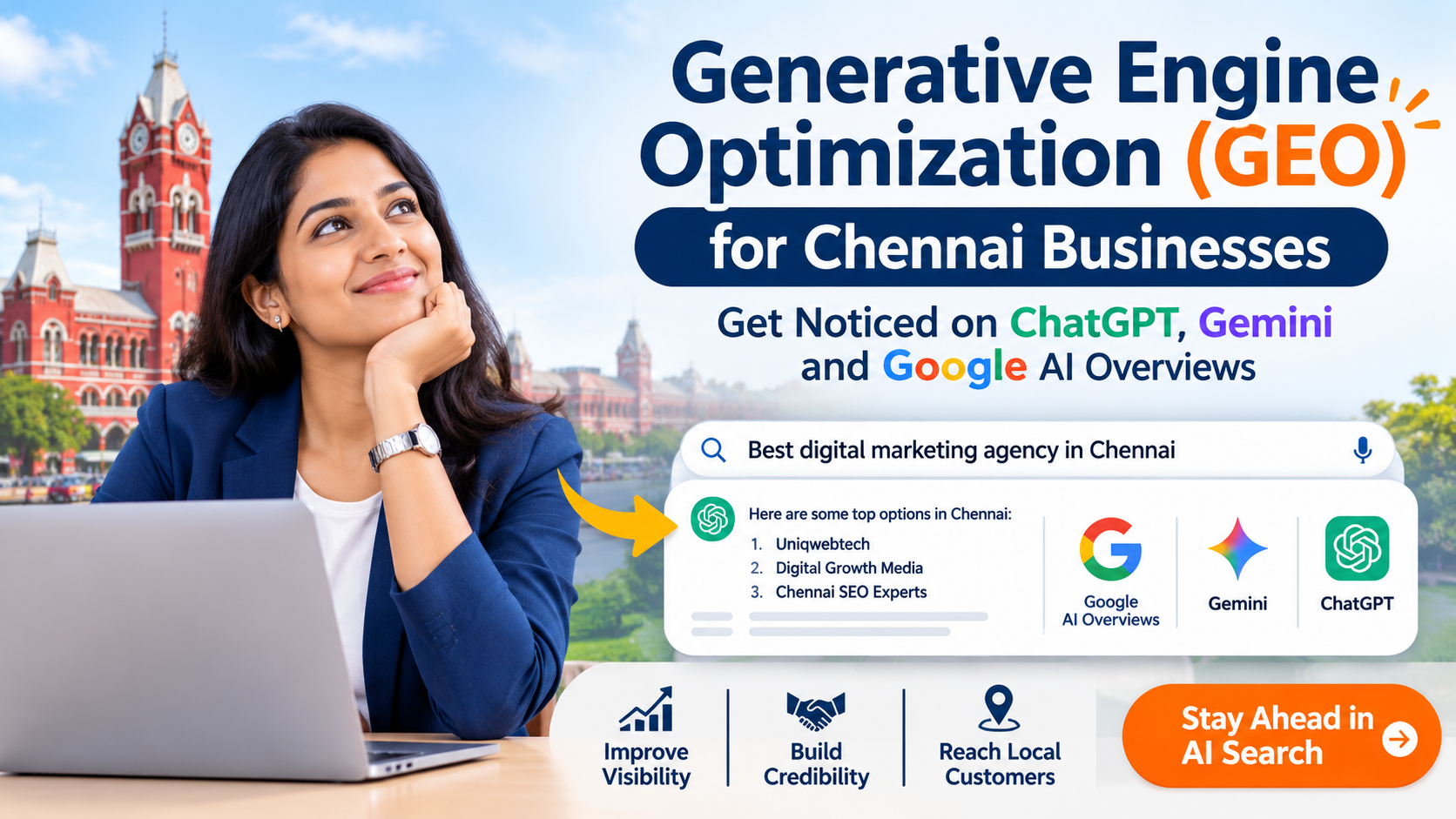
Within seconds, they get a list of businesses to consider.

Now think about your own business. Would it appear in that answer?

This is becoming an important question for businesses that want to stay visible online. People are changing the way they search for information. They’re no longer relying only on Google results. Many are also turning to AI tools to find companies, compare services and make buying decisions.

So, having a website and ranking on Google may not be the only things businesses need to think about anymore.

This is where Generative Engine Optimization, commonly known as GEO, comes into the picture.

What Is GEO?

Generative Engine Optimization (GEO) is about making your business easier for AI-powered platforms to understand, find and potentially mention when answering relevant questions.

Think about platforms like ChatGPT, Google Gemini, Perplexity and Google AI Overviews. When someone asks these tools for information or business recommendations, they generate answers using information available from different sources.

For a business, getting included in those answers could mean another opportunity to reach potential customers.

Traditional SEO focuses on improving your website’s visibility in search engine results. GEO looks at how your brand and content can become useful sources for AI-generated responses.

The idea is simple: Don’t just work towards getting people to visit your website. Make sure they can also discover your business when they search through AI tools.

SEO vs GEO: What’s Changing?

SEO and GEO are not competing strategies. They address different aspects of online visibility, and businesses can benefit from working on both.

Traditional SEO

GEO

Focuses on improving search engine rankings

Focuses on visibility in AI-generated answers

Aims to increase organic traffic and clicks

Aims to improve brand mentions and citations

Uses keywords, backlinks and technical optimization

Emphasizes useful content, credibility and clear information

Helps people find your website through search

Helps your business become discoverable through AI-powered platforms

A good SEO strategy still provides a strong foundation. A website with useful content, proper structure and relevant authority has a better starting point for building visibility across different search experiences.

What Makes AI Tools Notice a Business?

There is no guaranteed formula that makes ChatGPT or Gemini recommend a particular company. Their systems work differently, and the answers can change depending on the user’s question.

However, there are a few things businesses should pay attention to.

Clear information: Your website should explain your services, experience, location and contact details without making visitors search for them.

Consistent business details: Your company information should match across your website, Google Business Profile and other important online platforms.

Real customer feedback: Reviews and testimonials help potential customers understand what others think about your business.

Useful website content: Pages that answer genuine customer questions are more helpful than content created simply to include keywords.

A credible online presence: Relevant business mentions, industry publications, case studies and professional profiles can help people learn more about your brand.

These are not guaranteed AI ranking factors, but they are sensible ways to strengthen your business’s overall online presence.

7 Ways Chennai Businesses Can Improve Their GEO

You don’t need to make major changes to your website overnight. Start with the basics and improve your online presence step by step.

1. Understand What Your Customers Are Searching For

Before creating content, think about what your customers want to know.

For example, someone looking for an SEO agency in Chennai might ask:

How much does SEO cost in Chennai?

Which SEO services are suitable for a small business?

How long does it take to see SEO results?

How can I get more local customers through Google?

These are real questions worth addressing through your website content.

Instead of writing articles just to target keywords, create pages that answer these questions properly. Give readers a clear answer first, followed by useful explanations and examples.

2. Make Your Website Information Clear

Have you checked whether a first-time visitor can understand your business within a few seconds?

Your homepage should explain what your company does. Your service pages should describe what you offer, who can benefit from it and how customers can get in touch.

Avoid vague service descriptions and unnecessary technical language.

Use proper headings, descriptive page titles, internal links and relevant structured data such as Organization, LocalBusiness and Service schema.

These improvements help search engines understand your website more easily. They also make the information more useful to visitors.

3. Don’t Ignore Your Google Business Profile

For a business targeting customers in Chennai, local visibility matters.

Your Google Business Profile should have the correct business name, address, phone number, working hours and service information.

Add actual business photographs, share updates and respond to customer reviews.

Many customers check a business’s Google profile before visiting its website. An incomplete or outdated profile can create doubts, even if the website looks professional.

Keep it updated so customers can find the information they need.

4. Let Your Customers Talk About Your Business

People are more likely to trust a business when they can see genuine feedback from its customers.

Encourage satisfied customers to leave honest reviews on Google and other relevant platforms. Respond to feedback, answer questions and take negative reviews seriously.

Don’t rely on fake testimonials or purchased reviews. They may create a temporary impression, but they don’t build genuine trust.

Real customer experiences are far more valuable.

5. Build Your Brand Beyond Your Website

Your website is important, but it shouldn’t be the only place where people can find your business.

Look for opportunities to share useful information and build your presence on relevant platforms.

For example:

Publish informative articles on Medium and industry websites.

Share professional insights on LinkedIn.

Get listed in relevant local business directories.

Participate in industry discussions.

Explore guest posting opportunities on trusted websites.

Don’t submit content everywhere just for the sake of getting backlinks. Choose platforms where your potential customers are likely to spend time.

The objective is to build a genuine online presence around your brand.

6. Show What You Have Actually Achieved

Anyone can write that their company provides the best services. But what makes a potential customer believe that claim?

Show your work.

If you’ve helped a client improve website traffic, generate enquiries or improve search visibility, explain what you did and what changed.

For example, a digital marketing agency in Chennai could publish a case study explaining how it improved a local business’s organic visibility.

Include genuine results, the challenges involved and the steps taken to achieve them. Get permission before sharing client information.

This kind of content gives readers something useful to evaluate and helps demonstrate your experience.

7. Keep Your Business Details Consistent Everywhere

Imagine your website displays one phone number, your Google Business Profile shows another, and an online directory lists an outdated address.

Which information should a potential customer trust?

Small differences like these can create unnecessary confusion.

Check your website, social media pages, Google Business Profile and important directory listings. Make sure your business name, contact number, address, website URL and service information are accurate.

If you serve different areas of Chennai, mention them clearly. Just make sure you don’t list locations as physical offices unless your business actually operates there.

A Simple Example: A Dental Clinic in OMR

Let’s take an example of two dental clinics operating in OMR, Chennai.

The first clinic has a website that clearly explains its treatments, location, appointment process and available pricing information. It also answers common questions about dental implants, shares useful dental care information and maintains an updated Google Business Profile.

Patients have left genuine reviews, and the clinic’s contact details are consistent across its online listings.

Now consider another clinic. It has a basic website with very little information about its treatments. There are hardly any patient reviews, and visitors have to search around to find its contact details.

Which clinic gives a potential customer more reasons to trust it?
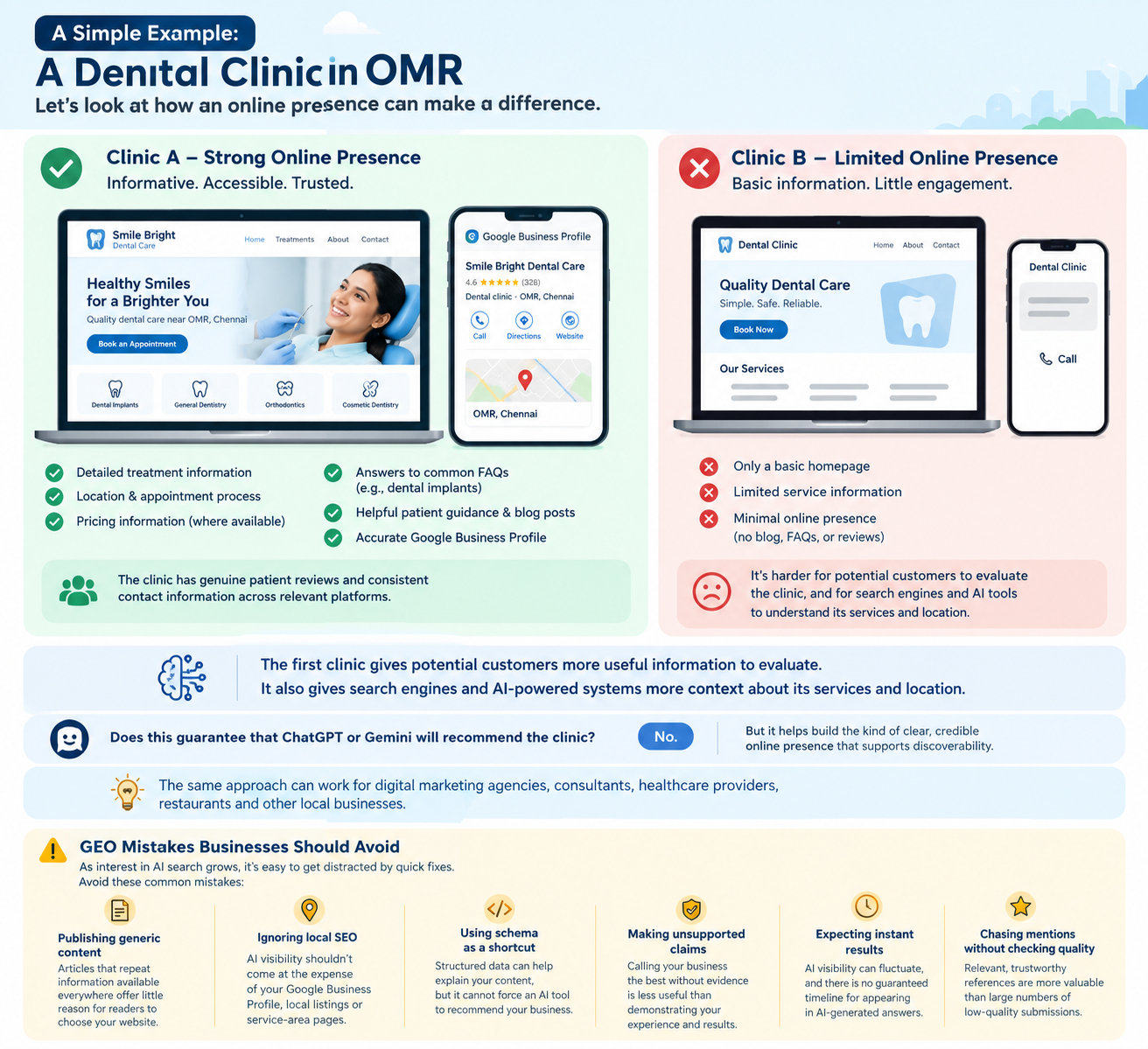
The first one.

It also provides search engines and AI-powered platforms with more useful information about its services and location.

Of course, this doesn’t mean ChatGPT or Gemini will automatically recommend that clinic. But a clear website, genuine reviews and a consistent online presence can make the business easier to discover and evaluate.

The same principle applies to almost every local business, whether it’s a dental clinic, digital marketing agency, restaurant or consultancy.

Common GEO Mistakes Businesses Should Avoid

As more businesses start paying attention to AI search, some may focus on shortcuts instead of building a strong online presence.

Here are a few mistakes worth avoiding:

Publishing content just for the sake of it: Rewriting the same information found on hundreds of websites won’t give visitors much reason to read yours.

Forgetting about local SEO: Don’t focus so much on AI visibility that you neglect your Google Business Profile and local listings.

Expecting schema to do everything: Structured data helps explain website information, but adding schema doesn’t guarantee AI recommendations.

Making claims without proof: Instead of repeatedly saying you’re the best, show your work, experience and customer feedback.

Expecting overnight results: Building online visibility takes time. AI-generated answers can also change from one search to another.

Submitting your business to every directory: Focus on relevant and trustworthy platforms rather than collecting hundreds of low-quality listings.

Frequently Asked Questions About GEO

1. Is GEO replacing traditional SEO?

No. SEO is still important for improving website visibility in search engines. GEO adds another layer by focusing on how your business and content can be discovered through AI-powered search experiences. Businesses should work on both.

2. How long does it take to see GEO results?

There is no fixed timeline. It depends on your website, existing online presence, competition and the quality of your content. Rather than expecting immediate recommendations, focus on improving your website and tracking your visibility over time.

3. Can small businesses in Chennai benefit from GEO?

Absolutely. Small businesses can improve their chances of being discovered by providing useful local information, maintaining genuine customer reviews and clearly explaining their services. You don’t need to be a large company to build a credible online presence.

4. How can I check whether ChatGPT or Gemini mentions my business?

Try asking questions that your potential customers might ask.

For example:

Which digital marketing agencies serve businesses in Chennai?

Which SEO companies work with small businesses in Chennai?

What should I check before choosing a digital marketing agency?

Check whether your business appears in the answers. Also look at which competitors are mentioned and whether the AI tools refer to any particular websites or sources.

Repeat these checks from time to time, as AI answers can vary. This gives you a simple way to monitor your brand’s visibility.

5. Do I need a separate website for GEO?

No. You can start with your existing website. Improve your service pages, publish useful content, update your business information and work on your overall SEO. These steps can also support your GEO efforts.

Is Your Business Ready for the Next Stage of Search?

The way people find businesses online is changing. Some still prefer Google search, while others are beginning to ask ChatGPT, Gemini and other AI tools for recommendations.

For businesses, this means online visibility needs more attention than ever.

A good website alone isn’t enough if it doesn’t explain your services properly. Regular content alone won’t help if it offers nothing useful. And having a Google Business Profile won’t make much difference if the information is outdated.

What matters is building a consistent online presence that gives customers a reason to choose your business.

At Uniqwebtech, we help businesses improve their online visibility through SEO, content marketing and digital marketing strategies.

Not sure how your business appears in Google search or AI-generated answers? Let’s take a look at your current online presence and find opportunities to improve it.

Uniqwebtech – Helping Businesses Build a Stronger Online Presence.
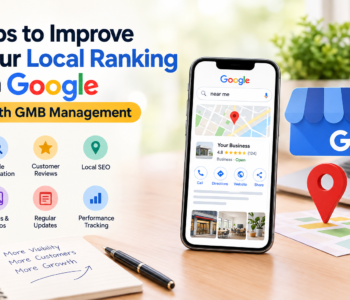
GMB management tips to improve local Google ranking. GMB Management

GMB Management: Tips to Improve Your Local Ranking on…

GMB management tips to improve local Google ranking.Improve your local Google ranking with effective GMB management—optimize your business profile, build customer trust, and attract more local customers.

Tips to Improve Your Local Ranking on Google

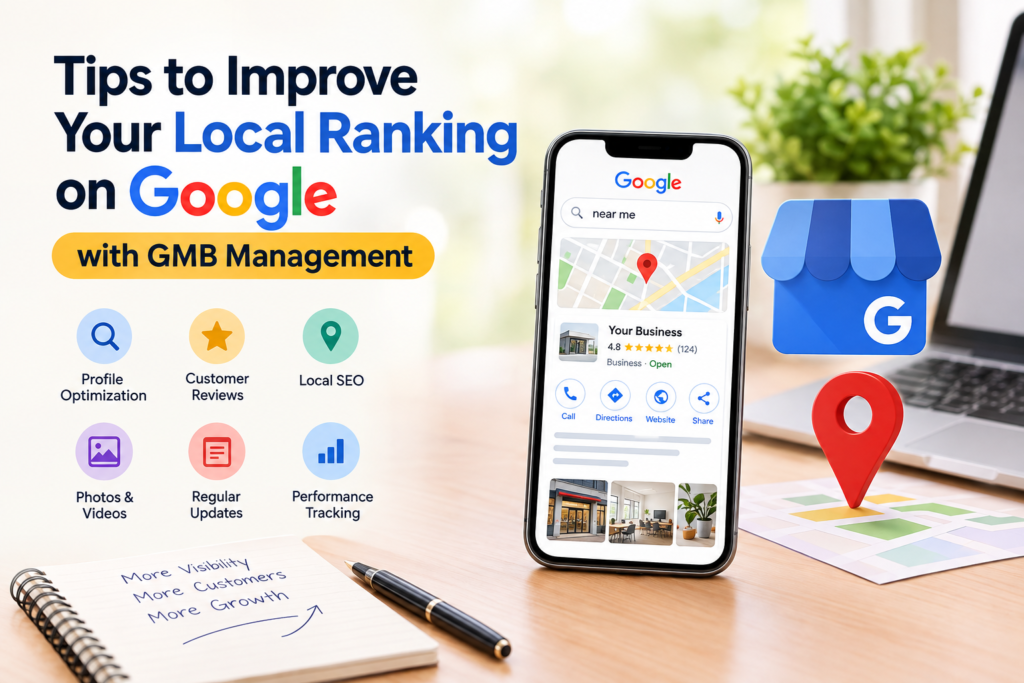
When customers search for a business near them, Google often displays local business listings before traditional search results. Whether someone searches for “SEO company near me,” “best painting contractor in Chennai,” “women’s gym near me,” or “digital marketing agency in Chennai,” appearing prominently in local search results can help businesses attract more calls, website visits, direction requests, and customers.

However, improving local visibility on Google requires more than simply creating a Google Business Profile and adding a few business details. Businesses need a consistent local SEO strategy that includes profile optimization, customer reviews, accurate information, relevant content, and regular GMB management.

GMB, commonly known as Google My Business, is now called Google Business Profile (GBP). The platform allows businesses to manage how their information appears across Google Search and Google Maps.

In this guide, we will explore practical tips to improve your local ranking on Google and explain how effective GMB management can support long-term local business growth.

1. Optimize Your Google Business Profile Completely

One of the first steps toward improving your local ranking is to ensure that your Google Business Profile is complete and accurate.

A partially completed profile may provide limited information to potential customers. A fully optimized profile makes it easier for people to understand your business, the services you provide, your location, and how to contact you.

Make sure your profile includes:

  • Correct business name
  • Relevant primary business category
  • Appropriate secondary categories
  • Accurate business address or service area
  • Updated phone number
  • Website URL
  • Business hours
  • Business description
  • Services and products
  • High-quality business images
  • Relevant attributes

Your business information should be consistent and accurate across your website, Google Business Profile, social media pages, and other business directories.

How GMB management helps: Regular profile audits can identify missing information, outdated business hours, incorrect service details, and other issues that may affect customer trust and local visibility.

Avoid adding unnecessary keywords to your business name. Your Google Business Profile name should reflect your actual business name rather than a list of target keywords.
To learn more about creating and managing your business profile, visit the official Google Business Profile  website.

2. Select the Right Primary and Secondary Categories

Google uses business categories to understand what a company offers. Selecting the right category helps Google connect your business with relevant local searches.

For example:

  • A painting contractor may select a painting-related business category.
  • A gym may choose a fitness-related category.
  • A digital marketing agency may select a marketing agency category.
  • A restaurant may choose a category that reflects its cuisine or service type.

Your primary category should represent the main service or purpose of your business. Secondary categories can be used when they accurately describe additional services.

Best practices for category selection

  1. Choose a category that closely matches your main service.
  2. Add secondary categories only when they are relevant.
  3. Review your competitors’ categories for research, not for copying.
  4. Avoid selecting unrelated categories to target more keywords.
  5. Revisit your categories when your business services change.

The right category can improve relevance for searches related to your products or services. However, category selection alone cannot guarantee higher rankings.

3. Use Relevant Keywords in Your Business Description

Your Google Business Profile description provides an opportunity to explain your business to potential customers. It can also help communicate the services and locations your business serves.

A useful description should be written for customers first, with relevant keywords included naturally.

For example, a digital marketing agency serving Chennai might use phrases such as:

Avoid excessive keyword repetition or writing descriptions that sound unnatural.

Example

Instead of writing:

Best SEO company Chennai SEO services Chennai SEO agency Chennai best SEO experts Chennai.

Write:

We provide SEO and digital marketing services for businesses in Chennai, helping them improve online visibility, attract relevant traffic, and generate quality leads through search engine optimization, content marketing, and social media strategies.

The second version is easier to read and communicates the business offering more clearly.

GMB management tip: Review your business description periodically to ensure that it accurately represents your current services and target audience.

4. Keep Your Business Information Consistent

Consistency is an important part of local SEO. Google and customers should be able to find the same core business information across different online platforms.

This includes:

  • Business name
  • Address
  • Phone number
  • Website
  • Opening hours
  • Service areas

For example, if your Google Business Profile displays one phone number while your website contains another, customers may become confused. Incorrect or outdated information can also reduce trust.

Check your business information on:

  • Google Business Profile
  • Official website
  • Social media profiles
  • Local directories
  • Industry-specific directories
  • Business listing platforms

Businesses that change locations, phone numbers, or working hours should update their information promptly.

A regular GMB management process can include checking profile information and maintaining consistency across major online listings.

5. Encourage Genuine Customer Reviews

Customer reviews play an important role in local business visibility and customer decision-making. Many people check reviews before contacting a business, visiting a store, or booking a service.

Businesses should encourage satisfied customers to share honest feedback about their experience.

Ways to generate more reviews

  • Ask customers after completing a service.
  • Share your official review link through email or messaging.
  • Add a review request to your follow-up process.
  • Make the review process easy to understand.
  • Train staff to request feedback professionally.
  • Thank customers for sharing their experiences.

Do not purchase fake reviews, create misleading reviews, or offer prohibited incentives in exchange for positive feedback. Reviews should reflect genuine customer experiences.

Respond to both positive and negative reviews

Responding to reviews demonstrates that your business values customer feedback.

For positive reviews, thank the customer and acknowledge their experience.

For negative reviews:

  1. Respond politely.
  2. GMB management tips to improve local Google ranking.Improve your local Google ranking with effective GMB management—optimize your business profile, build customer trust, and attract more local customers.Avoid arguing publicly.
  3. Acknowledge the concern.
  4. Offer to discuss the issue privately.
  5. Take appropriate action to resolve the problem.

Review management is not just about increasing the number of reviews. It is also about maintaining credibility and building customer relationships.

6. Publish Regular Google Business Profile Updates

Google Business Profile allows eligible businesses to share updates, offers, announcements, events, and other relevant information.

Regular updates can help keep your profile informative and engaging for customers.

You can publish content such as:

  • New service announcements
  • Seasonal offers
  • Business updates
  • Customer-focused tips
  • Product launches
  • Event information
  • Frequently asked questions
  • Special working hours
  • Recent project highlights

For example, a fitness center might publish a post about a new group class, while a painting contractor could share photos from a recently completed residential project.

Tips for creating effective profile posts

  • Use clear and relevant images.
  • Write concise, customer-friendly content.
  • Include a suitable call to action.
  • Avoid misleading claims.
  • Use relevant keywords naturally.
  • Keep information accurate and updated.

Google Business Profile posts should support your overall marketing strategy rather than replace your website content or other SEO activities.

7. Add High-Quality Photos and Videos

Visual content helps customers understand your business before they contact you. A profile with relevant, authentic images can provide more confidence than a profile with very little visual information.

Depending on your business type, you can add:

  • Exterior and interior photos
  • Team photographs
  • Product images
  • Service-related images
  • Before-and-after project photos
  • Equipment photographs
  • Workplace images
  • Short videos

For a restaurant, food and interior photographs may be useful. For a gym, images of the facilities, equipment, and training environment can help customers understand the experience. For a service business, project images can demonstrate the type of work performed.

Photo optimization tips

  • Use clear and authentic images.
  • Avoid uploading irrelevant photographs.
  • Keep images well-lit and professional.
  • Update photos regularly.
  • Showcase your actual location, team, products, or services.
  • Avoid excessive promotional text in images.

Images do not automatically guarantee better rankings, but they can improve the usefulness and credibility of your business profile.

8. Create Location-Specific Website Content

Your Google Business Profile and website should support each other. While your profile provides important business information, your website can offer detailed information about your services, locations, experience, and customer solutions.

If your business serves multiple locations, create useful location-specific content when there is a genuine reason to do so.

For example:

  • SEO services in Chennai
  • Painting services in Velachery
  • Digital marketing services in Tambaram
  • Women’s fitness center in Anna Nagar

Location pages should contain unique and helpful information. Avoid creating multiple pages that simply replace the city name while keeping the same content.

A useful location page may include:

  • Services available in the area
  • Relevant customer needs
  • Local service coverage
  • Business experience
  • Frequently asked questions
  • Customer testimonials
  • Contact information
  • Directions or service details

Use location keywords naturally in headings, page titles, descriptions, and body content. The content should provide genuine value to visitors instead of being created only for search engines.

9. Build Relevant Local Citations and Business Listings

Local citations are online mentions of your business information, often including the business name, address, and phone number.

Examples include:

  • Local business directories
  • Industry directories
  • Chamber of commerce listings
  • Regional business websites
  • Professional associations
  • Relevant local publications

When creating listings, prioritize quality and relevance over quantity.

Local citation best practices

  • Use accurate business information.
  • Select relevant directories.
  • Avoid spammy listing websites.
  • Maintain consistent contact details.
  • Update listings when information changes.
  • Do not create duplicate profiles unnecessarily.

Local citations can help reinforce business information and make it easier for customers to discover your company. Their value depends on the quality, relevance, and accuracy of the platforms where your business is listed.

10. Improve Your Website’s Local SEO

Your website experience can influence how customers interact with your business after discovering it through Google.

A well-optimized local business website should be:

  • Mobile-friendly
  • Fast-loading
  • Easy to navigate
  • Secure with HTTPS
  • Clear about services and locations
  • Simple to contact
  • Structured with relevant information

Important local SEO elements include:

Title tags and meta descriptions

Create page titles and meta descriptions that accurately describe your service and location where appropriate.

Example title:

SEO Company in Chennai | Local SEO & Digital Marketing Services

Local business information

Display your business contact details clearly on your website. If you have a physical location, provide appropriate address and contact information.

Service pages

Create detailed service pages that explain what you offer, who you serve, and how customers can contact you.

Structured data

Where appropriate, businesses can use relevant structured data, such as LocalBusiness schema, to help search engines understand business information. Structured data does not guarantee rich results or higher rankings, and it should reflect information visible on the page.

11. Focus on Customer Experience and Local Relevance

Google local results are generally influenced by factors associated with relevance, distance, and prominence. Businesses cannot control every factor, particularly the user’s location at the time of a search.

For example, a business located closer to a customer may appear for a local search even if another business has a larger online presence.

However, businesses can improve their relevance and visibility by maintaining accurate information, offering clear services, building a trustworthy reputation, and developing useful local content.

Ask yourself:

  • Does my profile clearly explain what my business offers?
  • Is my location or service area accurate?
  • Can customers easily contact me?
  • Are my reviews genuine and recent?
  • Does my website support my local search visibility?
  • Are my business listings consistent?

These questions can help you identify areas for improvement.
Google considers factors such as relevance, distance, and prominence when determining local search results. Understanding these factors can help businesses develop a more effective local SEO strategy. Read Google’s official guide on how to improve your local ranking on Google .

12. Monitor Your Google Business Profile Performance

Local SEO requires regular monitoring. Without tracking performance, it can be difficult to understand whether your optimization efforts are generating useful results.

Depending on the information available in your profile and analytics tools, you can monitor:

  • Customer calls
  • Website clicks
  • Direction requests
  • Search visibility
  • Profile interactions
  • Review growth
  • Customer enquiries
  • Leads generated through local search

You can also use Google Search Console and website analytics tools to understand how visitors reach your website.

Remember that profile views and website traffic are not the same as qualified leads. A successful local SEO strategy should focus on attracting relevant customers and supporting business objectives, not just increasing impressions.

Create a monthly tracking process

A monthly GMB management report may include:

|Metric|

What to Monitor

Profile information

Accuracy of business details

Search performance

Search visibility and discovery

Customer actions

Calls, website visits, and directions

Reviews

|New reviews and response status

Photos

New uploads and engagement

Posts

Updates published and interactions

|Website

Local traffic and conversion activity

Leads

Relevant enquiries and bookings

Tracking these details can help identify opportunities and guide future optimization.

13. Avoid Common Google Business Profile Mistakes

Some businesses make avoidable mistakes that can affect their profile quality and customer trust.

Common mistakes include:

  • Using an inaccurate business name
  • Selecting irrelevant categories
  • Adding incorrect business hours
  • Creating duplicate profiles
  • Using fake reviews
  • Ignoring customer feedback
  • Uploading poor-quality images
  • Adding unnecessary keywords
  • Creating misleading service areas
  • Failing to update business information

Businesses should follow Google’s applicable Business Profile guidelines and ensure that profile information represents their real operations.

If your profile experiences an issue, investigate the cause carefully rather than making frequent random edits.

14. Consider Professional GMB Management Services

Managing a Google Business Profile requires consistent attention. Business owners may find it challenging to handle profile updates, review responses, local SEO, photos, posts, and performance tracking while managing daily operations.

Professional GMB management services can support businesses with activities such as:

  • Google Business Profile setup
  • Profile optimization
  • Category research
  • Business information updates
  • Service and product updates
  • Google post creation
  • Review monitoring
  • Local citation management
  • Local SEO support
  • Performance reporting

A professional service provider should use accurate business information and follow Google’s policies. Avoid agencies that promise guaranteed first-place rankings or claim that they can control Google’s local search results.

The right approach is to focus on sustainable optimization, relevant content, customer experience, and consistent monitoring.

Conclusion: Improve Your Local Ranking with Consistent GMB Management

Improving your local ranking on Google is an ongoing process rather than a one-time activity. Businesses need to maintain accurate profile information, select relevant categories, encourage genuine customer reviews, publish useful updates, add authentic images, and optimize their websites for local search.

Effective GMB management brings these activities together into a consistent strategy. By monitoring your profile regularly and making improvements based on customer needs and performance data, you can strengthen your local online presence and create more opportunities for customer enquiries.

Whether you operate a local service business, retail store, fitness center, restaurant, or professional agency, your Google Business Profile can serve as an important part of your digital marketing strategy.

Want to improve your local visibility on Google? Invest in consistent GMB management, local SEO, and customer-focused content to build a stronger online presence and help potential customers discover your business.

Frequently Asked Questions

1. What is GMB management?

GMB management refers to the process of optimizing and maintaining a Google Business Profile. It may include updating business information, managing reviews, publishing posts, adding photos, monitoring performance, and supporting local SEO.

2. How long does it take to improve local Google rankings?

The time required varies depending on competition, location, business category, profile quality, website performance, reviews, and other factors. Local SEO improvements are not guaranteed to produce results within a fixed period.

3. Is Google Business Profile free?

Google Business Profile is generally available at no charge for eligible businesses. However, businesses may choose to pay professionals or agencies for profile optimization, ongoing management, content creation, and local SEO services.

4. Can reviews improve local SEO?

Genuine customer reviews can support customer trust and are among the factors associated with local business visibility. Businesses should focus on earning honest reviews and responding professionally rather than using fake or manipulated reviews.

5. Can GMB management guarantee the number-one position?

No legitimate GMB management provider can guarantee a permanent number-one position on Google. Local rankings can change based on relevance, distance, prominence, competition, and other factors. A professional provider should focus on ethical optimization and measurable business outcomes.