Category: <span>Digital Marketing</span>

The Art of Conversion Rate Optimization Digital Marketing

“The Art of Conversion Rate Optimization: Turning Visitors into…

Conversion rate optimization (CRO) is a crucial aspect of digital marketing that focuses on maximizing the number of website visitors who take a desired action, such as making a purchase, signing up for a newsletter, or filling out a form. By implementing effective CRO strategies, businesses can significantly increase their conversion rates and ultimately turn more visitors into customers. Here are some key principles and techniques to consider when it comes to the art of conversion rate optimization:


Define Clear Goals:

Before diving into CRO, it’s essential to define clear and specific goals for your website or landing page. These goals can be related to sales, lead generation, engagement, or any other relevant metric. Having well-defined goals will help you measure the success of your CRO efforts accurately.


Understand Your Target Audience:

To optimize conversion rates, you need to have a deep understanding of your target audience. Conduct thorough market research to identify their needs, preferences, pain points, and motivations. This information will enable you to tailor your messaging and design to resonate with your audience and increase the chances of conversion.


Analyze User Behavior:

Utilize analytics tools to track user behavior on your website. Analyze data such as page views, bounce rates, time on page, and click-through rates to identify areas of improvement. Heatmaps and user session recordings can provide valuable insights into how visitors interact with your site, allowing you to identify usability issues or bottlenecks in the conversion funnel.


Optimize Website Design and User Experience:

A visually appealing and user-friendly website is crucial for conversions. Ensure that your website is well-structured, loads quickly, and is mobile-responsive. Simplify the navigation process and make it easy for visitors to find the information they are looking for. Use persuasive design elements such as compelling headlines, clear call-to-action buttons, and engaging visuals to guide visitors towards the desired actions.


A/B Testing and Experimentation:

A/B testing involves creating two or more variations of a webpage and measuring the performance of each version. By testing different elements such as headlines, images, colors, layouts, and call-to-action placements, you can identify which variations yield the highest conversion rates. Continuously experiment and refine your website based on data-driven insights to optimize conversions.


ATTACHMENT DETAILSConversion-Rate-Optimization.


Optimize Landing Pages:

Landing pages play a crucial role in CRO. Ensure that your landing pages are specifically designed to match the intent of the traffic source that leads visitors to them. Keep the messaging consistent, highlight the benefits of your product or service, and minimize distractions. A well-optimized landing page can significantly improve conversion rates.


Leverage Social Proof:

Social proof, such as customer testimonials, reviews, ratings, and case studies, can help build trust and credibility. Display positive social proof prominently on your website to alleviate concerns and objections that potential customers may have. Testimonials and reviews from satisfied customers can act as powerful influencers in the decision-making process.


Implement Effective Call-to-Actions:

Strong, compelling, and action-oriented call-to-action (CTA) buttons are essential for driving conversions. Use clear and concise language to guide visitors towards the desired action. Experiment with different CTA designs, colors, and placements to optimize their effectiveness.


Personalization and Segmentation:

Tailoring your messaging and offers based on visitor segments or their previous interactions can significantly improve conversion rates. Utilize tools and technologies that enable personalization, such as dynamic content, targeted email campaigns, and personalized product recommendations.


Continuous Optimization:

Conversion rate optimization is an ongoing process. Monitor your conversion rates regularly, identify areas for improvement, and implement changes based on data and user feedback. Stay up-to-date with the latest CRO trends and best practices to refine your strategies and maintain a competitive edge.


Remember, successful conversion rate optimization requires a combination of data analysis, creativity, and a customer-centric approach. By applying these principles and techniques, you can enhance the effectiveness of your digital marketing efforts and turn more website visitors into valuable customers.


Various Types of Digital Marketing Digital Marketing

Various Types of Digital Marketing

What is digital marketing ? 

Digital marketing is the use of electronic media, such as the Internet, social media, mobile apps, and other Various types of digital marketing channels, to promote products and services and reach customers. It involves a variety of tactics and strategies,including search engine optimization (SEO), content marketing, email marketing, social media marketing, pay-per-click advertising, and affiliate marketing, among others.

Digital marketing allows businesses to reach and engage with customers online, and it can be an effective way to reach a large and targeted audience. It can be especially useful for small businesses and startups that may not have the resources to advertise through traditional channels, such as print, radio, or television.

Overall, the goal of digital marketing is to drive traffic to a business’s website and increase sales and revenue. It is an important part of a company’s overall marketing strategy and can help businesses of all sizes reach and engage with their target audience.
Various types of digital marketing 

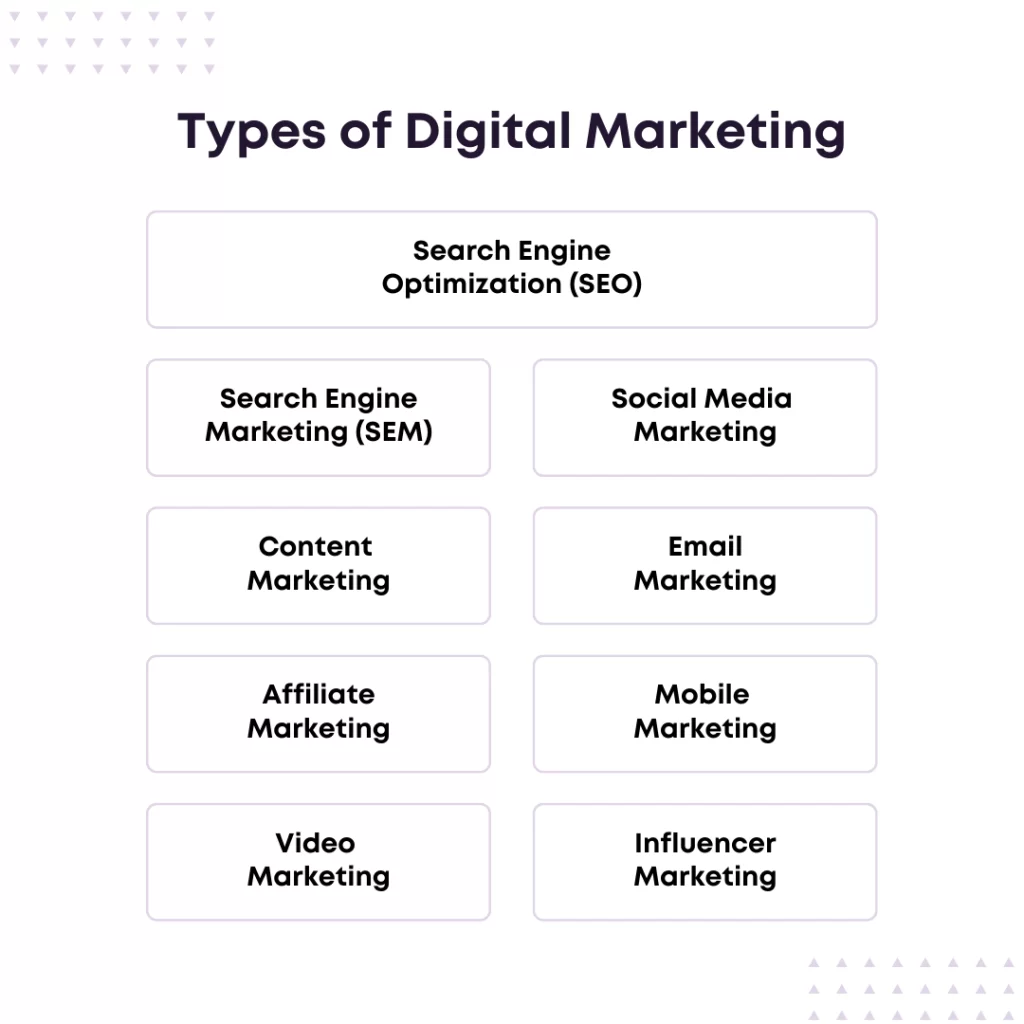
There are many different types of digital marketing that businesses can use to reach and engage with customers online. Some of the most common types include:

Search engine optimization (SEO): This involves optimizing a website and its content to rank higher in search engine results pages (SERPs) for specific keywords related to the business.

Content marketing: This involves creating and distributing valuable, relevant, and consistent content to attract and retain a clearly defined audience. The goal is to drive profitable customer action.

Email marketing: This involves sending marketing messages to a list of subscribers via email. It can be used to nurture leads, build relationships, and drive sales.

Social media marketing: This involves using social media platforms, such as Facebook, Twitter, and Instagram, to promote a business and its products or services.

Pay-per-click (PPC) advertising: This involves placing paid ads on search engines or other websites. Advertisers pay each time a user clicks on one of their ads.

Affiliate marketing: This involves promoting a business’s products or services on a third-party website and earning a commission for each sale or lead generated from that website.

Influencer marketing: This involves partnering with influential people or companies to promote a business’s products or services to their followers.

Video marketing: This involves using video to promote a business and its products or services. It can include creating and sharing videos on social media platforms, or using video advertising on websites.

Mobile marketing: This involves using mobile apps, SMS, and other mobile-specific channels to reach and engage with customers.

Local SEO: This involves optimizing a business’s online presence for customers in a specific geographic location.

These are just a few examples of the many types of digital marketing that businesses can use. The best approach will depend on the specific needs and goals of the business.

Search engine optimization (SEO)

Search engine optimization (SEO) is the process of optimizing a website and its content to rank higher in search engine results pages (SERPs) for specific keywords related to the business. The goal of SEO is to increase the visibility of a website and make it easier for potential customers to find it when they search for relevant keywords.

There are many factors that can affect a website’s ranking in search engine results, including the quality and relevance of the website’s content, the structure and organization of the website, the use of keywords, and the presence of backlinks from other websites. To optimize a website for search engines, it is important to focus on these factors and ensure that the website is easy to navigate, fast loading, and well-structured.

SEO can be a complex and time-consuming process, but it can be an effective way to improve a website’s visibility and drive traffic to the site. It is an important part of a company’s overall digital marketing strategy and can help businesses of all sizes reach and engage with their target audience.


Content marketing: 

Content marketing is a type of digital marketing that involves creating and distributing valuable, relevant, and consistent content to attract and retain a clearly defined audience. The goal of content marketing is to drive profitable customer action, such as making a purchase or signing up for a newsletter.

Content marketing can take many forms, including blog posts, articles, ebooks, infographics, videos, podcasts, and social media posts. The key is to create content that is useful, informative, and engaging for the target audience.

Effective content marketing requires a well-defined content strategy that aligns with the overall marketing goals of the business. This includes identifying the target audience, determining the types of content that will be most effective, and creating a plan for promoting and distributing the content.

Content marketing can be a powerful way to build brand awareness, establish thought leadership, and drive traffic and sales. It is an important part of a company’s overall digital marketing strategy and can help businesses of all sizes reach and engage with their target audience.

Email marketing

Email marketing is a type of digital marketing that involves sending marketing messages to a list of subscribers via email. It can be used to nurture leads, build relationships, and drive sales.

To be effective, email marketing campaigns should be well-planned and targeted to the specific needs and interests of the audience. This includes segmenting the email list into smaller groups based on factors such as demographics, location, or past purchasing behavior, and creating customized content for each group.

Emails should be visually appealing and easy to read, and should include a clear call to action, such as a link to a product page or a sign-up form. It is also important to track the performance of email campaigns and analyze data such as open rates, click-through rates, and conversion rates to determine what is working and what can be improved.

Overall, email marketing can be an effective way to reach and engage with customers and drive sales. It is an important part of a company’s overall digital marketing strategy and can help businesses of all sizes reach and engage with their target audience.

Social media marketing

Social media marketing is the process of using social media platforms, such as Facebook, Twitter, Instagram, LinkedIn, and others, to promote a business and its products or services. It can be an effective way to reach and engage with a large and targeted audience and drive traffic and sales.

To be effective, social media marketing requires a well-defined strategy that aligns with the overall marketing goals of the business. This includes identifying the target audience, determining the types of content that will be most effective, and creating a plan for promoting and distributing the content.

Effective social media marketing involves creating and sharing high-quality, relevant, and engaging content that resonates with the target audience. This can include blog posts, articles, videos, images, and other types of content that provide value to the audience. It is also important to interact with followers and respond to comments and messages in a timely and professional manner.

Overall, social media marketing can be a powerful way to build brand awareness, establish thought leadership, and drive traffic and sales. It is an important part of a company’s overall digital marketing strategy and can help businesses of all sizes reach and engage with their target audience.

Pay-per-click (PPC) advertising:

Pay-per-click (PPC) advertising is a type of digital marketing in which advertisers place paid ads on search engines or other websites. Advertisers pay each time a user clicks on one of their ads.

PPC advertising can be an effective way to reach and engage with potential customers and drive traffic and sales to a website. It allows businesses to target specific keywords and demographics, and to control their budget by setting a maximum cost per click (CPC) for their ads.

To be effective, PPC campaigns require careful planning and targeting. This includes identifying the target audience, choosing the right keywords, and creating compelling ad copy and landing pages. It is also important to track the performance of PPC campaigns and analyze data such as click-through rates (CTRs), conversion rates, and cost-per-conversion to determine what is working and what can be improved.

Overall, PPC advertising can be a powerful way to reach and engage with potential customers and drive traffic and sales to a website. It is an important part of a company’s overall digital marketing strategy and can help businesses of all sizes reach and engage with their target audience.

Digital Marketing

Affiliate marketing:

Affiliate marketing is a type of digital marketing in which a business promotes its products or services on a third-party website and earns a commission for each sale or lead generated from that website. Affiliates are typically individuals or companies who have a website or social media presence and are willing to promote a business’s products or services to their followers in exchange for a commission.

To be effective, affiliate marketing requires a well-defined affiliate program that clearly outlines the terms and conditions for affiliates, including the commission structure, payment terms, and promotional guidelines. It is also important to choose affiliates who are a good fit for the business and who have a relevant and engaged audience.

Effective affiliate marketing involves creating high-quality products or services and providing affiliates with the resources and support they need to promote them effectively. This can include promotional materials, such as banners and links, as well as training and support for affiliates.

Overall, affiliate marketing can be a powerful way to reach and engage with potential customers and drive traffic and sales to a website. It is an important part of a company’s overall digital marketing strategy and can help businesses of all sizes reach and engage with their target audience.

Influencer marketing:

Influencer marketing is a type of digital marketing in which a business partners with influential individuals or companies to promote its products or services to their followers. Influencers are typically individuals or companies with a large and engaged following on social media or other online platforms.

To be effective, influencer marketing requires careful planning and targeting. This includes identifying the right influencers for the business and its products or services, and establishing clear terms and conditions for the partnership, including any compensation or incentives for the influencer.

Effective influencer marketing involves creating high-quality products or services and providing influencers with the resources and support they need to promote them effectively. This can include promotional materials, such as product samples or discount codes, as well as training and support for influencers.

Overall, influencer marketing can be a powerful way to reach and engage with potential customers and drive traffic and sales to a website. It is an important part of a company’s overall digital marketing strategy and can help businesses of all sizes reach and engage with their target audience.

Video marketing:

Video marketing is the use of video to promote a business and its products or services. It can be an effective way to reach and engage with potential customers and drive traffic and sales to a website.

There are many different ways to use video in marketing, including creating and sharing videos on social media platforms, using video advertising on websites, and including video on a company’s website or landing pages. The key is to create high-quality, relevant, and engaging videos that provide value to the target audience.

To be effective, video marketing requires a well-defined strategy that aligns with the overall marketing goals of the business. This includes identifying the target audience, determining the types of videos that will be most effective, and creating a plan for promoting and distributing the videos.

Effective video marketing involves creating compelling video content and promoting it through a variety of channels, such as social media, email, and paid advertising. It is also important to track the performance of video campaigns and analyze data such as view counts, engagement rates, and conversion rates to determine what is working and what can be improved.

Overall, video marketing can be a powerful way to reach and engage with potential customers and drive traffic and sales to a website. It is an important part of a company’s overall digital marketing strategy and can help businesses of all sizes reach and engage with their target audience.

Mobile marketing

Mobile marketing is the use of mobile apps, SMS, and other mobile-specific channels to reach and engage with customers. It can be an effective way to reach and engage with a large and targeted audience and drive traffic and sales.

There are many different ways to use mobile marketing, including creating mobile apps, sending SMS messages, and using mobile advertising on websites and social media platforms. The key is to create mobile experiences that are relevant, engaging, and convenient for the target audience.

To be effective, mobile marketing requires a well-defined strategy that aligns with the overall marketing goals of the business. This includes identifying the target audience, determining the types of mobile experiences that will be most effective, and creating a plan for promoting and distributing the content.

Effective mobile marketing involves creating compelling mobile experiences and promoting them through a variety of channels, such as app store optimization, SMS marketing, and mobile advertising. It is also important to track the performance of mobile campaigns and analyze data such as download rates, engagement rates, and conversion rates to determine what is working and what can be improved.

Overall, mobile marketing can be a powerful way to reach and engage with potential customers and drive traffic and sales to a website. It is an important part of a company’s overall digital marketing strategy and can help businesses of all sizes reach and engage with their target audience.

Local SEO

Local SEO is the process of optimizing a business’s online presence for customers in a specific geographic location. It involves optimizing a website and its content to rank higher in search engine results pages (SERPs) for keywords related to the business and its location.

To be effective, local SEO requires a well-defined strategy that aligns with the overall marketing goals of the business. This includes optimizing the website for specific keywords and phrases related to the business and its location, as well as ensuring that the website is easy to navigate, fast loading, and well-structured.

Local SEO also involves claiming and optimizing local business listings on platforms such as Google My Business, Yelp, and Bing Places. This includes providing accurate and up-to-date information about the business, such as the address, phone number, and business hours, as well as adding photos and reviews to the listing.

Overall, local SEO can be an effective way to improve a business’s online visibility and drive traffic and sales from local customers. It is an important part of a company’s overall digital marketing strategy and can help businesses of all sizes reach and engage with their target audience.

How to Build a Strong Brand Reputation Digital Marketing

How to Build a Strong Brand Reputation 

How to Build a Strong Brand Reputation

Starting your own business and building a brand reputation is always a huge challenge no matter what industry you’re in. It takes a lot of time, energy and money to get things off the ground, but it’s so worth it when you see your business grow.

One of the most important reasons why you should focus on your brand reputation is that it will help you attract new customers and keep the ones you have. A strong reputation will make people want to do business with you because they know they can trust you.

In this article, we’re going to share with you some tips on how to build a strong brand reputation.

1. Be consistent with your branding

This is one of the most important aspects of building a strong brand reputation. You need to be consistent with everything related to your brand, from your logo and website design to the way you answer customer queries.

Being consistent with your branding will make you more recognizable and memorable, which is crucial for building a strong reputation. It’s also important to make sure that your branding evolves as your business grows.

2. Build relationships with influencers

Another great way to build a strong brand reputation is by building relationships with industry influencers. These are people who have a large following and are respected in their field.

If you can get an influencer to endorse your product or service, it will give you a lot of credibility and help you build a strong reputation. For example, if you’re a small business owner, you could reach out to a local blogger and offer them a free product in exchange for a review.

3. Be active on social media

Social media is a great platform for building brand awareness and reputation. It allows you to connect with your target audience, share your content, and interact with other users.

There are a few things you should keep in mind when using social media for your business. First, you need to be active and post regularly. Second, you need to interact with other users and respond to comments and queries. And third, you need to make sure that your content is high-quality and relevant to your audience.


How to Build a Strong Brand Reputation 

4. Deliver on your promises

If you want to build a strong brand reputation, you need to make sure that you deliver on your promises. This means providing a high-quality product or service that meets customer expectations.

It’s also important to keep your word when it comes to things like delivery times and customer service. If you say you’re going to do something, make sure you do it.

This is especially important when it comes to dealing with negative reviews. If a customer is unhappy with your product or service, make sure you respond in a timely manner and do everything you can to resolve the issue.

5. Get involved in your community

Another great way to build a strong brand reputation is by getting involved in your community. This could involve supporting local charities or sponsoring events.

Not only will this help you build a good reputation, but it will also make you more visible in your community. And as a bonus, it’s a great way to connect with potential customers.

We also can’t neglect to mention it’s just a good way to give back to your community. The people who live there are the reason your business exists, so it’s important to show your appreciation.

6. Encourage customer feedback

Finally, you should encourage customer feedback. This could be in the form of online reviews or survey responses.

Positive reviews will help you build a strong reputation, while negative reviews can give you valuable insights into how you can improve your product or service.

Customer feedback is a great way to show that you care about your customers and that you’re always looking to improve.

7. Partner with an SEO agency

Building your brand reputation online mainly happens through strong SEO practices. Today, there are many options on how you can develop your SEO strategy. For instance, you can start creating the strategy from scratch by yourself. This is a good move if you have years of experience in the field, but it’s not the best option for people who are just getting into it.

In the second scenario, it’s better to partner with an agency. In fact, even people who think they can handle themselves can benefit from partnering with an agency as it will leave them room and time to do other things.

Another benefit of using an agency is that you’re spoiled for choice today. Since most digital agencies work online, you can easily go for the best SEO agency from Sydney, New York, or London without having to worry about the quality of the work you receive. This means you can take the time to find your perfect fit, regardless of where it is located.

Additionally, agencies already have strong reputations and years of experience, so the path to success will be significantly shorter.

8. Focus on your website

Your website is one of the most important tools you have for building a strong brand reputation. It’s the first place potential customers will go to learn more about your business, so it’s important to make sure it makes a good impression.

Your website should be well-designed and easy to navigate. It should also be updated regularly with fresh content. And of course, it should be optimised for search engines so that potential customers can easily find it.

9. Look at the competitors

Next, it’s important to keep an eye on your competitors. This will help you stay ahead of the curve and ensure that you’re always offering something unique.

Competitor analysis is a great way to find new ideas and to see what’s working well for other businesses in your industry.

You can do this by keeping an eye on their social media accounts, reading their blog posts, and subscribing to their email newsletters. If you’re good at networking, you might also want to attend their events and meetups. This way, you can get a first-hand look at what they’re doing and how they’re interacting with their customers.

10. Stay up to date with industry news

It’s important to stay up to date with industry news. This will help you identify new trends and opportunities. For instance, if you’re in the fashion industry, you might want to follow fashion bloggers and influencers.

This will help you see what’s popular at the moment and adapt your product or service accordingly. You can also use this information to create content that’s relevant to your audience.

You shouldn’t just keep an eye on trends on how to approach your audience. Keep an eye out for new technology, too, as it can help you automate some of your processes or even improve your product.

Conclusion

Building a strong brand reputation takes time and effort. But it’s worth it. A strong reputation will help you attract new customers, retain existing ones, and even charge more for your product or service.

So, if you’re looking to build a strong brand reputation, follow the tips above. And always remember that it’s a marathon, not a sprint. Rome wasn’t built in a day, and neither will your reputation.


5 reasons why visitors are not converting Digital Marketing

5 reasons why visitors are not converting ?

5 reasons why visitors are not converting ?

Have you ever wondered why some people visit your website and leave without making a purchase? Instead of spending more money and effort in growing your site traffic, focusing on improving your conversions can result in a better ROI.

Here are the 5 reasons why your business may be doing below its potential.

Targeting the Wrong Visitors

Often you could have a great product and a well-designed website with plenty of traffic but you still don’t see many people purchasing.

In this situation, the foremost common reason is that the visitors you’ve got coming to your website are the sort of individuals who would never buy from you they need to be drawn to your website either by mistake or by an advertising campaign that made promises which it could not meet.

Some users could be curious about only gaining information, and not making a sale, which is why your conversion rate can never be an ideal 100%. But if you’re lucky enough, you might be able to enter the top 10% with a conversion rate of 12% or higher.

The Buying Process Is Complex

According to reports, around 70% of users abandon a purchase due to the buying process being very complex.

Customers do not like to waste time setting up an account to make a purchase. They find it and would rather visit another store than make an account to purchase from your e-commerce store. It will be better allowing guest logins and getting obviate this problem permanently. Also, refrain from collecting personal details from your users as it stops them.

Always the clients like to quit fast from the website, so getting them with a quicker process will be far better than the complex process.

There’s Nobody to Answer Their Questions

Online shopping can be troublesome, especially if a buyer faces a problem with no apparent solution. This is one of the most important drawbacks of online shopping as there’s nobody ahead of you to unravel your problem, unlike in physical stores where you’ve got a salesperson helping you in the process.

Businesses can overcome this issue by having an in-depth commonly asked question section. And also introducing a live chat feature to allow visitors to get their questions answered on the spot without having to wait for long hours or pick a phone to make a call. The main thing is that being protective of the client is engaging. Good service welcomes customers.

Five reasons why visitors are not converting ?

They Do Not Find What They Need

One of the leading causes of low conversion rates is visitors’ failure to seek out what they’re trying to find. Provide a search feature with the ability to look for a product based on gender, size, price, etc.

Users prefer to shop online due to ease. If they are not able to find what they’re looking for, they’ll be disappointed and abandon the purchase.

Your marketing strategy should be clever as well. Do not promote what you do not sell. This point is important considering many businesses use keywords only to attract customers, even when they do not have that specific product for sale.

Your Website Isn’t Secure Enough

The buying process includes sharing personal information like MasterCard details, names, and addresses. Many users are not comfortable in giving such details online due to a fear of data breaches.

You must make your site secure to make sure visitors aren’t apprehensive of providing their details. It is as important to let people know your website is secure as to have a secure website. Use third-party trusted payment processors, enable HTTPS:// and mention your site security level on every page. Being transparent and creating a relationship built on trust can help to improve sales.

Why Is Digital Transformation So Important Today Digital Marketing

Why Is Digital Transformation So Important Today?

Digital Transformation

Technological advances are changing everything. Today, it’s obvious that you no longer choose technology – you have to implement it into your business strategy if you want to become or stay successful. Due to its numerous benefits, the digital transformation of businesses has become more and more popular and necessary over the years. If you think digital transformation is important today, can you even imagine what it is going to be like in the future? Be smart, learn how digital transformation can improve your business already today, and start benefiting from it as soon as possible!

What is digital transformation?

Digital transformation refers to the implementation of digital technologies into the business. You cover all of the areas of business and you do it to build more sustainable relationships and to improve the customer experience. Digital technologies allow you to do your business more efficiently and they improve your connection to the customers. All of this is bound to increase your profit and improve your reputation.

However, you shouldn’t just look at digital transformation in one way. Some would say that digital transformation creates a platform for you where you can be creative and discover a lot of new things. For instance, finding new frontiers to push your business and new ways to interact with customers while making it easier for employees as well might be just some of the ways to use digital technologies in your workplace.

Quicker and more effective service

No matter what you do, you must be a consumer as well. Since we live in an age where we can get everything we need within minutes and without even getting out of bed, it’s safe to say that we’re used to getting things quickly and efficiently. This is what people will expect from your business as well, simply because they’re used to it.

Since customer satisfaction is one of the business goals, you should never disregard this. That is exactly why it is necessary to implement all the possible strategies to make your business suitable for the average customer. Thanks to IT services and their agility, this isn’t impossible and it can be done as soon as you update your IT sector.

Improved security

Being one of the business priorities, security is definitely a feature you would like to invest in. Keeping the data secure is not an easy task, especially if you think about the possible attacks. No matter how challenging shielding against them can be, you should still do everything you can to protect your business.

There are a lot of threats that could endanger the business you’re conducting. Digital technologies can make your life easier in this area as well. With the necessary insurance software, you won’t have to worry about losing money.  Instead, you could just focus on gaining more and providing a higher quality service.

More efficiency

While you and the customers will benefit from the digital transformation undoubtedly, there is a group of people whose lives will be completely changed because of it. Your employees will feel this transformation the most and there is no question there. Implementing digital solutions will make their work-life easier in numerous ways. Having all of the digital tools at their disposal will facilitate their job without negatively impacting the final product!

Not only will the final product be as good as ever, but it will also be done faster! Due to an improved decision-making process and better communication between the employees, they’ll be able to get more work done in fewer hours and with significantly less energy and time invested. With satisfied employees, you won’t be just an entrepreneur of the year; you’ll be the boss of the year as well!

Greater profitability

You are probably already aware of the numerous costs a business can have. Sometimes, you waste money without even realizing it. For instance, if you fail to implement digital strategies, you may be spending more money on the production process than necessary. As soon as you start using digital tools, you’ll see the difference. You will be saving time, materials, and money.

There are other ways to benefit from this as well. For instance, digital marketing can affect your business in many positive ways. You can create a larger online presence and draw traffic to your website efficiently. More traffic means more potential customers and better rankings. This will all increase your business profitability and it will make you more than happy that you’ve invested in these strategies in the first place.

Stronger business partnerships

Digital transformation can improve your business, your employees’ working conditions, your customer satisfaction, and your profit. However, that isn’t everything. Digital transformation can even improve your business partnerships. Depending on the customer demands, the competition in your niche might be fierce at times.

That means that having a good relationship with other firms might help your business grow. Suppliers, distributors, consultants, and sub-contractors are all part of staying in the market and being relevant. Partnering with others is required today and managing these partners can be a piece of cake with the magic call digital transformation. Timely, accurate, and transparent workflow is a must-have and these technologies allow it to happen quickly and flawlessly.

Conclusion

Digital transformation is necessary today if you want your business to excel, especially by today’s standards. The bar is very high and customers know what they want. The sooner you understand that and start implementing these strategies, your business will be more profitable than ever before!

How to Maximize Your Brand Building Efforts on LinkedIn Digital Marketing

How to Maximize Your Brand Building Efforts on LinkedIn

Optimize your LinkedIn profile:

Your LinkedIn profile is your digital brand representation. Make sure it showcases your brand identity effectively. Use a professional profile picture, write a compelling headline and summary, and include relevant keywords that align with your brand and industry.


Linkedin Branding

Develop a content strategy:

Create a content strategy that aligns with your brand goals and target audience. Determine the types of content you want to share, such as articles, videos, or infographics, and establish a consistent posting schedule. Your content should be valuable, informative, and relevant to your audience’s interests and needs.

Share thought leadership content:

Position yourself as a thought leader in your industry by sharing insightful and unique content. Offer industry insights, trends, analysis, and expert opinions. This will help establish your brand’s credibility and attract a following of professionals who value your expertise.

Engage with your network:

Actively engage with your network by responding to comments, initiating conversations, and sharing valuable insights. This helps foster relationships, build trust, and expand your brand’s reach. Participate in relevant LinkedIn groups and communities to connect with like-minded professionals and share your expertise.

Leverage LinkedIn Pulse and articles:

LinkedIn Pulse is a publishing platform that allows you to share long-form articles directly with your network. Utilize this feature to provide in-depth content, share case studies, or discuss industry trends. Publishing articles on LinkedIn enhances your visibility and establishes you as an authority in your field.

Collaborate with others:

Collaborate with influencers, industry experts, or complementary brands to expand your reach and gain exposure to new audiences. Engage in cross-promotion, guest posting, or co-creating content to leverage each other’s networks and enhance your brand’s visibility.

Utilize LinkedIn ads:

Consider using LinkedIn’s advertising features to amplify your brand’s reach. LinkedIn ads allow you to target specific audiences based on job titles, industries, or demographics, ensuring your content reaches the right professionals. Experiment with different ad formats, such as sponsored content, text ads, or sponsored InMail messages, to find the most effective approach for your brand.

Analyze performance and iterate:

Regularly monitor the performance of your content using LinkedIn analytics. Evaluate metrics such as views, engagement, click-through rates, and follower growth. Analyze the data to understand what resonates best with your audience and adjust your content strategy accordingly.

By implementing these strategies, consistently creating valuable content, and actively engaging with your network, you can maximize your brand building efforts on LinkedIn and establish a strong presence within your industry

Benefits of Digital Marketing Digital Marketing
Benefits of Digital Marketing

Benefits of Digital Marketing

Digital marketing plays an important role in modern trading systems. These systems make our business faster and more precise. Digital marketing is more affordable than traditional offline marketing methods. It reaches the maximum customer audience, and with the help of digital marketing, you can do just that.

Unleashing the Power of Digital Marketing: A Comprehensive Look at its Benefits

In the digital age, businesses are increasingly recognizing the immense potential of digital marketing. This dynamic and ever-evolving approach to marketing offers a wide array of benefits, revolutionizing the way companies connect with their audience, build brand presence, and drive business growth. Let’s delve into the elaborate benefits of digital marketing:

Expanded Reach and Global Presence:
Digital marketing erases geographical boundaries and allows businesses to extend their reach far beyond their local markets. With online advertising, social media campaigns, and content marketing strategies, companies can connect with a vast global audience. This expanded reach opens up new avenues for growth, customer acquisition, and market penetration.

Cost-Effectiveness and Optimized Budget Allocation:
Compared to traditional marketing channels, digital marketing is often more cost-effective and offers higher return on investment (ROI). It allows businesses to optimize their budget allocation by precisely targeting their desired audience. With tools like pay-per-click (PPC) advertising and social media ads, companies can tailor their campaigns to reach specific demographics, interests, and online behaviors, ensuring that every dollar spent yields maximum impact.

Targeted Advertising and Personalization:
Digital marketing enables precise audience targeting and personalization. Through data-driven analytics and user profiling, businesses can understand their customers better and deliver tailored messages and experiences. This targeted approach increases the effectiveness of marketing efforts, as messages resonate with the right people at the right time, leading to higher conversion rates and customer engagement.

Measurable Results and Real-Time Analytics:
One of the major advantages of digital marketing is the ability to measure and track results accurately. Analytics tools provide in-depth insights into website traffic, customer behavior, conversion rates, and campaign performance. This data empowers businesses to make informed decisions, refine strategies, and allocate resources effectively. Real-time analytics enable continuous monitoring, allowing companies to adapt quickly to market trends and optimize their marketing campaigns for maximum impact.

Enhanced Customer Engagement and Relationship Building:
Digital marketing offers numerous channels for engaging with customers and fostering meaningful relationships. Social media platforms, email marketing, and personalized content enable businesses to connect directly with their audience, address their needs, and provide valuable insights. Engaged customers are more likely to become loyal advocates, spreading positive word-of-mouth and driving brand loyalty.


Infographic – Benefits of Digital Marketing

Benefits of Digital Marketing

Increased Brand Awareness and Differentiation:
Through digital marketing, businesses can build strong online presences and increase brand visibility. Engaging content, social media campaigns, and search engine optimization (SEO) tactics enable companies to differentiate themselves from competitors, capturing attention, and leaving a lasting impression on their target audience. Consistent brand messaging and storytelling across digital platforms strengthen brand identity and recognition.

Flexibility and Agility:
Digital marketing offers flexibility and agility, allowing businesses to adapt quickly to changing market dynamics. Campaign durations, targeting options, and ad formats can be adjusted easily based on real-time data and consumer insights. This agility enables companies to stay ahead of the competition, optimize their strategies, and seize new opportunities as they arise.

Equal Opportunities for Businesses of All Sizes:
Digital marketing provides equal opportunities for businesses of all sizes. It has leveled the playing field, allowing startups and small businesses to compete with larger corporations. With strategic digital marketing efforts, even companies with limited resources can gain visibility, attract customers, and establish themselves as industry players.

The benefits of digital marketing are far-reaching and transformative. By embracing this powerful approach, businesses can amplify their reach, engage with customers on a deeper level, and drive sustainable growth in the digital landscape. As technology continues to advance, digital marketing will remain a crucial tool for businesses seeking to thrive in an increasingly competitive and interconnected world.

Local Business SEO Tips and Tactics Digital Marketing

Local Business SEO Tips and Tactics

Local Business SEO Tips and Tactics

Optimizing your local business for search engines is crucial for attracting customers in your area. Here are some effective SEO tips and tactics specifically tailored for local businesses:

Create and Optimize Your Google My Business (GMB) Profile:

  • Claim and verify your GMB listing to ensure accuracy and control over your business information.
  • Provide complete and consistent details, including business name, address, phone number, website URL, and business hours.
  • Select relevant categories that describe your business.
  • Encourage customers to leave reviews on your GMB profile.

Optimize Your Website for Local Keywords:

  • Research and target relevant local keywords that include your location and industry.
  • Incorporate these keywords naturally in your website’s content, meta tags, headings, and URLs.
  • Create location-specific landing pages if your business operates in multiple areas.

Develop Localized Content:

  • Create blog posts, articles, or resources that address local topics, events, or news related to your industry.
  • Include location-specific information and references to demonstrate your relevance to the local community.

Build Local Citations:

  • Citations are mentions of your business name, address, and phone number (NAP) on other websites.
  • Ensure consistent NAP information across all online directories, review sites, and local business listings.
  • Seek opportunities to get listed on reputable local directories, industry-specific directories, and chamber of commerce websites.

Local Business SEO Tips and Tactics

Obtain Online Reviews:

  • Encourage your customers to leave reviews on platforms like Google, Yelp, and other relevant review sites.
  • Respond to reviews, both positive and negative, to show engagement and build customer trust.

Utilize Local Structured Data Markup:

  • Implement schema markup on your website to provide search engines with specific local business information, such as your address, phone number, business hours, and reviews.
  • This helps search engines understand and display your information accurately in search results.

Optimize for Mobile:

  • Ensure your website is mobile-friendly and responsive to provide a seamless user experience for mobile users.
  • Optimize page load times, improve mobile navigation, and make sure all content is easily readable on smaller screens.

Local Link Building:

  • Build relationships with local organizations, businesses, and influencers to earn local backlinks.
  • Sponsor local events, participate in community activities, or contribute to local charities to generate local backlinks and increase your visibility within the community.

Use Local Schema Markup:

Implement local business schema markup on your website to provide search engines with structured data about your business, including your address, phone number, opening hours, and customer reviews.

Monitor and Analyze Performance:

  • Regularly track and analyze your website’s performance using tools like Google Analytics and Google Search Console.
  • Monitor local search rankings, website traffic, user behavior, and conversion rates to identify areas for improvement and adjust your SEO strategy accordingly.

Remember, optimizing for local SEO is an ongoing process. Consistently monitoring and refining your local SEO efforts will help your business gain visibility, attract local customers, and stay ahead of the competition in your area.


Will Best Seo Marketing Companies Ever Rule the World Digital Marketing

Will Best Seo Marketing Companies Ever Rule the World?

Best Seo Marketing Companies

While SEO marketing companies play a significant role in helping businesses improve their online presence and visibility, it’s unlikely that they will “rule the world” in the traditional sense.


SEO is one aspect of digital marketing:

SEO is an essential part of a comprehensive digital marketing strategy, but it is not the sole determining factor for a business’s success. Other elements, such as social media marketing, paid advertising, content marketing, and customer experience, also contribute to overall marketing effectiveness.

Benefits Of Using An  Best Seo Marketing Companies:

The field of SEO is constantly evolving as search engines update their algorithms and user behavior changes. This dynamic nature means that no single entity can completely dominate or control the SEO landscape.

Diverse business needs:

Different businesses have diverse goals, target audiences, and marketing budgets. There isn’t a one-size-fits-all solution, and businesses often require customized strategies tailored to their specific needs and objectives.


Why SEO Important ?

Competition and innovation:

This helps in the development of search engine rankings. For example, a top SEO company can design a website to get it to the top. Through SEO promotional activities, the website can develop the ranking of its website.

SEO activities bring exceptional results to the website. The results will be faster and higher than ever before, i.e.

Client collaboration and internal efforts:

While SEO marketing companies can provide expertise and guidance, successful SEO strategies often require collaboration between the company and the marketing agency. Clients need to provide insights about their business, target audience, and industry, and also actively participate in the implementation and maintenance of SEO efforts.

Global diversity and local expertise:

SEO requirements vary across different regions and markets due to cultural, linguistic, and geographical factors. Localized knowledge and expertise are crucial to achieving success in specific markets. Therefore, a single SEO marketing company cannot effectively dominate every local market worldwide.

Conclusion:

It’s important to note that SEO marketing companies can significantly contribute to a business’s online success by providing expert guidance, strategies, and implementation. However, the world of marketing is multifaceted, and success requires a comprehensive and integrated approach that goes beyond SEO alone.

The next big thing Digital Marketing As A Service Digital Marketing

The next big thing Digital Marketing As A Service

Digital Marketing As A Service

Digital Marketing as a Service (DMaaS) is indeed an emerging trend that offers businesses a comprehensive and outsourced solution for their digital marketing needs. It involves partnering with a digital marketing agency or service provider to handle various aspects of a company’s digital marketing strategy and execution

All-in-one digital marketing solution:

DMaaS provides businesses with a full suite of digital marketing services, including search engine optimization (SEO), pay-per-click (PPC) advertising, social media marketing, content creation, email marketing, analytics, and more. It offers a holistic approach to digital marketing, ensuring that all aspects work together seamlessly.

Digital Marketing As A Service


Expertise and resources:

DMaaS allows businesses to leverage the expertise and resources of professional digital marketing agencies. These agencies have specialized knowledge, experienced teams, and access to cutting-edge tools and technologies. They stay updated with industry trends and best practices, helping businesses stay competitive and achieve their marketing goals.

Scalability and flexibility:

DMaaS offers scalability, allowing businesses to adjust their digital marketing efforts based on their evolving needs. As companies grow or launch new campaigns, they can easily scale their digital marketing services up or down. It provides flexibility in terms of budget allocation and resource allocation.

Cost-effective solution:

Outsourcing digital marketing through DMaaS can be cost-effective compared to hiring an in-house marketing team or managing multiple vendors. With DMaaS, businesses pay for the services they need, avoiding the costs associated with hiring and training employees, purchasing software, and maintaining infrastructure.

Focus on core business activities:

By outsourcing digital marketing, businesses can focus on their core activities and leave the marketing tasks to the experts. It frees up internal resources, allowing the company to allocate time and energy towards core business operations and strategic decision-making.

Data-driven approach:

DMaaS providers often leverage data analytics to measure and optimize marketing campaigns. They track key performance indicators (KPIs), provide detailed reports, and make data-driven recommendations to improve campaign effectiveness. This data-driven approach helps businesses make informed decisions and optimize their marketing efforts for better ROI.

Continuous improvement and innovation:

DMaaS providers are committed to staying ahead of industry trends and evolving technologies. They continuously adapt their strategies, test new approaches, and implement innovative techniques to deliver optimal results for their clients. This ensures that businesses benefit from the latest advancements in digital marketing.

DMaaS is a promising solution for businesses looking to streamline their digital marketing efforts and achieve results without the burden of managing it all internally. However, it’s important for businesses to carefully evaluate and choose a reputable and experienced DMaaS provider that aligns with their specific goals and requirements.

escort mersin
× How can I help you?